Preface: The Emerging Reality
In response to the multi-faceted ecological crisis that the Earth is facing, a new reality is emerging. It recognizes a very old truth, that we humans are inseparable from Nature, and that to nurture the health of the Earth is also to nurture our own health, the health of the species. Our well-being, our survival—even our sense of meaning—are intimately tied to the health of the living Earth. To nurture the Earth is to nurture ourselves. To heal the planet is to heal the human spirit.
At the same time, it’s difficult to ignore the overwhelming evidence that humanity, in its current mode of existence, has become a dangerously destabilizing force. It is tempting, and not altogether unjustified, to view our species as a plague—a rogue organism behaving parasitically toward the very systems that sustain it. We are clearly in a condition of overshoot: consuming far more than Earth’s regenerative capacity can sustain, emitting more carbon than ecosystems can absorb, extracting more than the biosphere can replenish. As the ecological economist William Catton wrote in his prescient 1980 book Overshoot, such a condition inevitably leads to collapse unless a radical course correction is made. We need to dial back the harm that we are causing, and accelerate the restoration of healthy ecosystems, communities, and belief systems. As James Lovelock writes. in Healing Gaia(1991):
Sometimes in anguish, concerned environmentalists ask if humans have become a leukemia of the Earth. Are we an organism that broke with the great community of Eden or of Gaia? Are we now breeding without restraint until our numbers and toxins compromise the entire body of the Earth? It might seem so but leukemic cells do not debate their destructive role, nor consider a change of behaviour that might curb their own numbers. True, our presence on Earth has already changed the land surfaces and the atmosphere adversely. If we believe this to be a planetary disease then we need planetary medical advice now. Practical advice on how to restore a state of health.
Lovelock’s words still resonate. His analogy challenges us not merely to reduce emissions or protect endangered species, but to see ourselves as part of a living body—an organism capable of self-reflection, and therefore of self-correction. Unlike leukemic cells, we can recognize our impact and choose to change our behavior. The great question of our time is whether we will do so fast enough, and at a sufficient scale, to avert terminal decline.
This spirit of reflection and responsibility also animated the work of Donella Meadows, co-author of The Limits to Growth and one of the founding thinkers of modern systems science. Along with colleagues from around the world, she created the Balaton Group, a network of sustainability scientists, policy leaders, and activists. One of their key insights was that global change must be rooted in local regeneration—that every bioregion needed its own ecological learning center, a place where people could study, adapt, and collaborate to maintain the integrity and vitality of their home ecosystems.
In our own early work toward this vision, we issued an invitation to like-minded individuals and organizations:
“Civilization is in crisis. We need to transform just about everything if we are going to survive. Our Mission is to foster the transition to a clean, sustainable, and regenerative economy for the benefit of all. It’s going to take everything we’ve got, but it’s possible.
If we continue what we’re doing, and everyone else continues what they’re doing, things will turn out badly for the Earth. All of us need to change.”
This may sound stark, but it reflects the sobering reality of our moment in history. The unraveling of climate systems, the collapse of biodiversity, the acidification of oceans, the poisoning of soils—these are not abstract concerns. They are already impacting food security, displacing populations, and destabilizing societies. And the longer we wait, the more the window for effective response closes.
But there is good news.
People are changing. Around the world, individuals and communities are waking up—often in the face of grief, loss, and disruption—to the profound interconnectedness of all life. They are organizing, experimenting, learning, and rebuilding. They are refusing to succumb to fatalism or paralysis. And they are finding each other.
These emerging movements are not just about conservation or sustainability. They are about reclaiming humanity’s rightful role in the web of life—not as conqueror or parasite, but as keystone species: a steward, a nurturer, a contributor to the flourishing of the whole.
This book is about those movements. It is about the people who are daring to imagine and enact a different kind of future—one rooted in care, reciprocity, and ecological intelligence. It is about the shift from being an apex predator to becoming a partner in co-evolution with the rest of life on Earth.
We still have time—just barely—to change course. What’s needed now is not only the right tools and technologies, but the courage to change our story. A story in which we humans, having come close to destroying our home, rise to become its healers.
*Inspired by and dedicated to my wife and co-conspirator Victoria Zelin-Cloud.
Author Bio:
Jonathan Cloud is the Executive Director of the Center for Regenerative Community Solutions (CRCS), a nonprofit organization advancing climate and community resilience through regenerative financing initiatives such as C-PACE in New Jersey. Over more than four decades, his work has spanned sustainable development, cooperative enterprise, and systemic transformation.
He has served as a consultant, educator, and social entrepreneur, helping communities, businesses, and institutions move toward more just and regenerative models of prosperity. His work integrates ecological restoration, local self-reliance, and innovative financial tools to accelerate the transition to a habitable future.
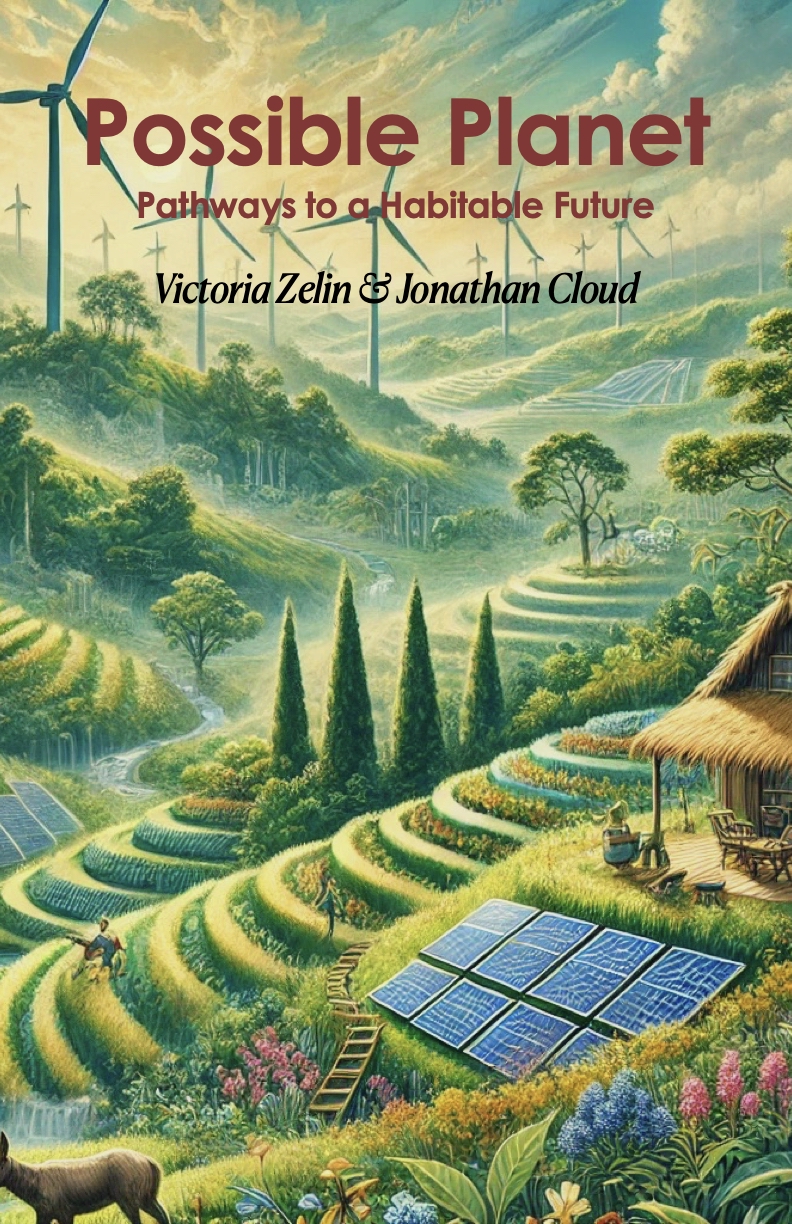
Through CRCS and allied initiatives, Jonathan has focused on bridging the gap between visionary thinking and practical implementation—aligning capital with community, and climate action with human flourishing. Possible Planet: Pathways to a Habitable Future reflects this lifelong inquiry into how humanity can co-create a thriving Earth for generations to come.
[wpdatatable id=1]